How Much Jail or Prison Time Can You Face for Aggravated Assault in Arizona?
Aggravated assault in Arizona can result in penalties ranging from probation without incarceration in eligible cases to more than 20 years in prison. The applicable sentence depends on the felony classification, whether dangerous-offender sentencing applies, qualifying prior convictions, the alleged victim’s age or protected status and any offense-specific sentencing requirements.
If you or a loved one has been charged, the charge and allegations listed in the charging document are only the starting point. Prosecutors may allege dangerousness or prior convictions that increase sentencing exposure. Defense counsel can evaluate whether those allegations are legally and factually supported.
This guide from The Nava Law Firm, PLLC explains how sentences for aggravated assault in Arizona are determined, when probation may be available, and how a defense attorney may help protect your rights.
Is Aggravated Assault a Felony in Arizona?
Yes. Aggravated assault offenses under A.R.S. § 13-1204 range from class 6 felonies to class 2 felonies. Simple assault under A.R.S. § 13-1203 is generally a misdemeanor; it becomes aggravated assault when a circumstance listed in § 13-1204 applies.
The circumstance alleged generally determines the felony classification, subject to additional victim-specific provisions.
These are summaries, not substitutes for reviewing the precise subsection charged. Protected-worker provisions have different requirements concerning the victim’s duties, the defendant’s knowledge and the nature of the assault.
An eligible non-dangerous class 6 felony may be designated a misdemeanor or left undesignated during probation under A.R.S. § 13-604. However, an undesignated conviction remains a felony for specified purposes, including firearm possession and future sentencing enhancements, until the court designates it a misdemeanor.
What Determines the Potential Sentence for Aggravated Assault?
Three principal factors determine sentencing exposure: the felony class, whether dangerous-offender sentencing applies and the defendant’s qualifying prior convictions. Victim-related facts, the extent of injury and offense-specific sentencing requirements can also affect the available sentence.
Felony Class and Specific Allegations
For a first-time felony offender who is not sentenced under the dangerous-offender statute or another special sentencing provision, A.R.S. § 13-702 provides the following prison ranges.
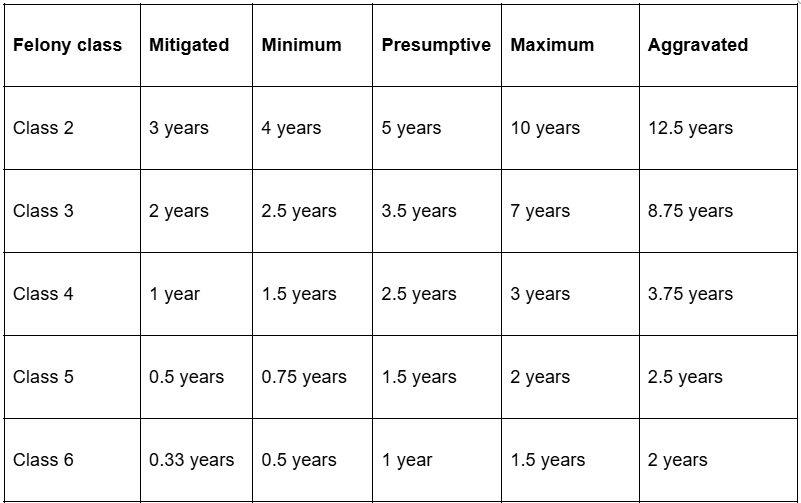
The presumptive term is the statutory starting point for a prison sentence. Aggravating and mitigating circumstances can support a higher or lower term.
The aggravated term generally requires at least two qualifying aggravating circumstances admitted by the defendant or found true beyond a reasonable doubt by the trier of fact, subject to the statutory exception for the prior-felony aggravator. The mitigated term requires at least two mitigating circumstances found by the court.
Probation may be available for some first-time, non-dangerous offenses, but other statutory restrictions must also be considered.
Dangerous-Offense Allegations and Prior Convictions
Arizona defines a dangerous offense as one involving the discharge, use, or threatening exhibition of a deadly weapon or dangerous instrument, or the intentional or knowing infliction of serious physical injury.
When dangerous-offender sentencing under A.R.S. § 13-704 applies, prison is mandatory and probation is unavailable.
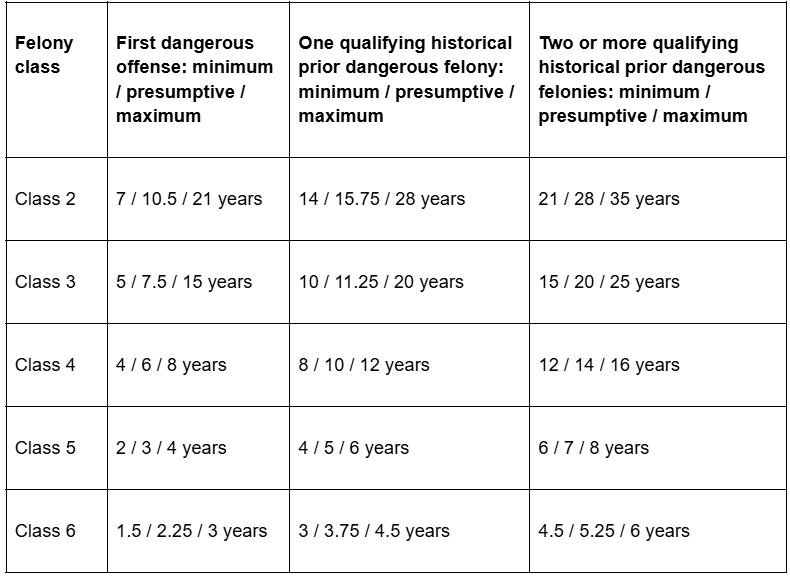
For class 2 and class 3 offenses, the prior-conviction columns shown above require qualifying historical prior convictions for class 1, 2, or 3 dangerous felonies.
Non-dangerous prior felony convictions may also affect sentencing. The applicable sentencing scheme depends on the current offense and the nature and legal status of the prior convictions. Multiple dangerous offenses committed on separate occasions but consolidated for trial may also trigger enhanced ranges. Out-of-state convictions require a separate analysis to determine whether they qualify.
A first-time defendant sentenced for a standard class 3 dangerous aggravated assault faces 5 to 15 years in prison, with a presumptive term of 7.5 years, unless another sentencing provision applies.
Serious Physical Injury and Victim-Related Factors
The nature of an injury and the alleged victim’s age or protected status can change the felony classification or trigger special sentencing requirements.
- Serious physical injury: This includes an injury creating a reasonable risk of death, serious and permanent disfigurement, serious impairment of health, or loss or protracted impairment of the function of a bodily organ or limb. It generally makes aggravated assault a class 3 felony, subject to victim-specific enhancements. Serious injury qualifies under the dangerous-offense definition when inflicted intentionally or knowingly.
- Fractures or temporary but substantial disfigurement or impairment: These generally make aggravated assault a class 4 felony. Whether dangerous-offender sentencing applies requires a separate analysis.
- Children under 15: Aggravated assault involving serious physical injury or a deadly weapon or dangerous instrument against a child under 15 may be subject to A.R.S. § 13-705. A first completed aggravated assault sentenced under the applicable dangerous-crimes-against-children provision carries 10 to 24 years with a presumptive term of 17 years.
- First responders, law-enforcement-agency employees and prosecutors: Specified serious-injury or weapon-based assaults are class 2 felonies. Certain intentional or knowing aggravated assaults on first responders require imprisonment of at least the presumptive term. Certain assaults on peace officers also carry a two-year enhancement.
Aggravating circumstances under A.R.S. § 13-701 such as specified victim-age factors, the presence of an accomplice or emotional or financial harm may also affect the sentence.
How Much of a Prison Sentence Must Be Served?
A prison sentence and the amount of time actually served are related but distinct issues.
Earned-release eligibility depends on the applicable sentencing statutes and the defendant’s eligibility for credits. Many Arizona prison sentences permit release after service of approximately 85% of the imposed term, but that is not a universal rule or a guaranteed release date.
Certain offenses require service of the full imposed prison term, subject to narrow statutory exceptions. These include specified intentional or knowing assaults on first responders and completed aggravated assaults sentenced as first-degree dangerous crimes against children.
The two-year peace-officer enhancement does not, by itself, establish that the entire sentence must be served without earned-release credits. The specific statutory provisions governing the conviction must be reviewed.
When Could Probation Be Available?
Probation may be available when the defendant is not sentenced as a dangerous offender and no other statutory restriction requires prison.
First-time and non-dangerous status alone do not guarantee eligibility. Certain intentional or knowing aggravated assaults on first responders require imprisonment independently of the general dangerous-offender statute.
When probation is legally available, the judge decides whether to grant it. Relevant considerations may include the incident, injury, criminal history, treatment needs, work and family circumstances, and the victim’s input.
Under A.R.S. § 13-902, ordinary felony-probation periods may last up to:
- Seven years for a class 2 felony.
- Five years for a class 3 felony.
- Four years for a class 4 felony.
- Three years for a class 5 or class 6 felony.
The statute permits extensions in certain circumstances, including unpaid restitution.
Probation does not necessarily mean no jail. A judge may order up to one year in county jail as a condition of felony probation, along with treatment, no-contact conditions, restitution, fines, and other requirements. Violating probation can lead to revocation and a prison sentence under the applicable sentencing range.
For an eligible non-dangerous class 6 felony, a judge may designate the offense a class 1 misdemeanor or leave it undesignated. This discretionary option generally does not apply to a person with two or more previous felony convictions. While the offense remains undesignated, specified felony consequences continue to apply.
How Can a Plea Agreement Affect Sentencing?
A plea agreement can substantially change sentencing exposure. Depending on the evidence and applicable law, negotiations may involve:
- Dismissing a dangerousness allegation, potentially making probation available if no other restriction applies.
- Amending or reducing the charge to an offense with a lower felony classification.
- Withdrawing prior-conviction allegations that would otherwise increase the sentencing range.
- Dismissing additional counts, potentially reducing exposure to consecutive sentences.
- Agreeing to probation, a jail cap, a specific prison term or a sentencing range, subject to court approval.
- Resolving the case as misdemeanor assault.
- Resolving an eligible charge as an undesignated class 6 felony with the possibility of later misdemeanor designation.
An undesignated class 6 conviction is not the same as a final misdemeanor designation.
A plea generally waives the right to trial and limits available avenues for review, although post-conviction remedies may remain available. Court acceptance and sentencing provisions are governed by procedural rules; the parties’ agreement does not eliminate the court’s role.
Before accepting an offer, a defendant should understand the evidence, available defenses, sentencing terms and consequences for immigration status, firearm rights, and future criminal cases.
Additional Consequences Beyond Incarceration
An aggravated assault conviction can have consequences beyond jail or prison.
- Fines, surcharges and restitution: Felony fines can reach $150,000 plus surcharges. Restitution may include qualifying economic losses such as medical expenses and lost wages.
- Firearm restrictions: A felony conviction generally prohibits firearm possession unless rights are lawfully restored. Restoration may be restricted or unavailable for certain offenses.
- Civil-rights consequences: A felony conviction affects voting, jury service and eligibility to hold public office, subject to applicable restoration rules.
- Limits on set-asides and record sealing: These are separate remedies with different eligibility rules. Dangerous offenses are excluded from both, and additional exclusions apply to certain child-victim offenses, serious offenses and offenses with specified weapon or injury elements. Waiting longer does not cure a statutory exclusion.
- Immigration consequences: For noncitizens, an aggravated assault conviction may lead to removal, inadmissibility or naturalization problems. The exact offense elements and sentence matter.
- Employment and professional licensing: A conviction may affect licensing, background checks, and employment opportunities.
- Domestic-violence consequences: A qualifying domestic relationship may support a domestic-violence designation with additional consequences depending on the conviction and court orders.
- Future sentencing exposure: A conviction may qualify as a historical prior felony or otherwise affect sentencing in a later case.
Because these consequences vary, resolving a case involves more than comparing prison terms. See our guide to restoring your rights after a conviction in Arizona.
How Defense Counsel May Challenge the Charge or Sentencing Allegations
Defense counsel can evaluate both the underlying charge and the allegations that increase sentencing exposure. Successfully challenging an allegation may reduce the felony classification, prison range or restrictions on probation.
Challenging the Underlying Charge
- Self-defense or defense of others: When evidence of a legally applicable justification defense is presented, the State must prove beyond a reasonable doubt that the defendant did not act with justification.
- The required mental state: The State must prove the mental state required for the particular assault alleged. An accidental injury does not, by itself, establish aggravated assault.
- Identification and credibility: Video, phone records, 911 recordings, medical evidence, and witness accounts may support or undermine the allegation.
- Constitutional violations: Counsel may seek suppression of evidence or statements when legally justified. Not every search issue, identification problem or failure to give Miranda warnings requires suppression.
Challenging Sentencing Allegations
- Weapon or dangerous-instrument allegations: Whether an object is a dangerous instrument depends on the circumstances of its use. Mere presence of an object does not, by itself, establish discharge, use or threatening exhibition.
- Injury allegations: Medical evidence may affect whether the State can establish serious physical injury, a fracture or another qualifying injury.
- Victim status: Counsel can examine whether the statutory requirements concerning the victim’s status, duties, and the defendant’s knowledge are satisfied.
- Prior convictions: Counsel can review whether alleged priors are valid, qualify under the applicable sentencing statute and satisfy any relevant timing requirements.
- Mitigation: Relevant evidence may include remorse, provocation, mental-health circumstances, treatment efforts, military service, family responsibilities and lack of a criminal record.
At The Nava Law Firm, our attorneys evaluate the charge, available defenses and sentencing allegations to identify options for trial preparation and plea negotiations.
Frequently Asked Questions About Aggravated Assault Penalties
What Is the Minimum Jail Time for Aggravated Assault in Arizona?
Some aggravated assault offenses are eligible for probation without jail time. There is no single minimum that applies to every case.
When a first offense is sentenced under the dangerous-offender statute, the minimum prison term ranges from 1.5 years for a class 6 felony to seven years for a class 2 felony. Other statutory provisions can require different sentences or independently bar probation.
How Much Prison Time Can Aggravated Assault With a Deadly Weapon Carry in Arizona?
Aggravated assault with a deadly weapon is generally a class 3 felony. If sentenced as a first dangerous offense under A.R.S. § 13-704, it carries 5 to 15 years in prison with a presumptive term of 7.5 years.
The victim’s age or protected status, qualifying prior convictions and other sentencing provisions can change that exposure.
Can I Get Probation for Aggravated Assault in Arizona?
Possibly. Probation may be available for an eligible non-dangerous offense when no prior-conviction rule or offense-specific statute requires imprisonment.
Dismissing a dangerousness allegation may help, but it does not guarantee probation eligibility or a probation sentence.
Is Aggravated Assault Always a Felony in Arizona?
Aggravated assault under A.R.S. § 13-1204 is classified as a class 2 through class 6 felony. An eligible non-dangerous class 6 conviction may be designated a misdemeanor under a separate statute. A negotiated resolution may also involve misdemeanor assault.
How Much of a Prison Sentence Must Be Served in Arizona?
Release eligibility depends on the conviction and governing statutes. Many sentences permit earned-release eligibility after approximately 85% of the term, but some require service of the full imposed prison term.
Specified assaults on first responders and completed aggravated assaults sentenced as dangerous crimes against children have special restrictions.
Can a Prior Conviction Increase My Sentence?
Yes. Qualifying historical prior felony convictions can substantially increase sentencing exposure. For example, a class 3 dangerous offense with one qualifying historical prior class 1, 2, or 3 dangerous felony carries 10 to 20 years under A.R.S. § 13-704.
Whether an Arizona or out-of-state conviction qualifies requires a case-specific legal analysis.
Can Aggravated Assault Charges Be Dropped or Reduced?
Yes. Dismissal or reduction may be possible when the evidence is insufficient, justification applies, injury or weapon allegations cannot be established or important evidence is suppressed. A negotiated plea may also reduce the charge or sentencing allegations. No particular outcome is guaranteed.
Talk to a Phoenix Aggravated Assault Defense Attorney
An aggravated assault charge can carry substantial prison exposure, but an arrest does not determine the outcome. Defense counsel can assess the felony classification, dangerousness allegation, prior-conviction allegations and available defenses. Early involvement can help preserve evidence and identify defense and sentencing options.
The Nava Law Firm, PLLC represents people charged with aggravated assault including aggravated assault with a deadly weapon throughout Phoenix, Scottsdale, Mesa, Tempe, Chandler and the rest of Maricopa County.
Founding attorney Armando Nava and the firm’s criminal-defense team can evaluate the allegations and explain the options available in your case.
Call 602-975-4990, available 24/7, or request a free consultation online. Our office is at 1641 E. Osborn Rd., #8, Phoenix, Arizona 85016.